
The Science of Internal Stress Released During Metal Leveling
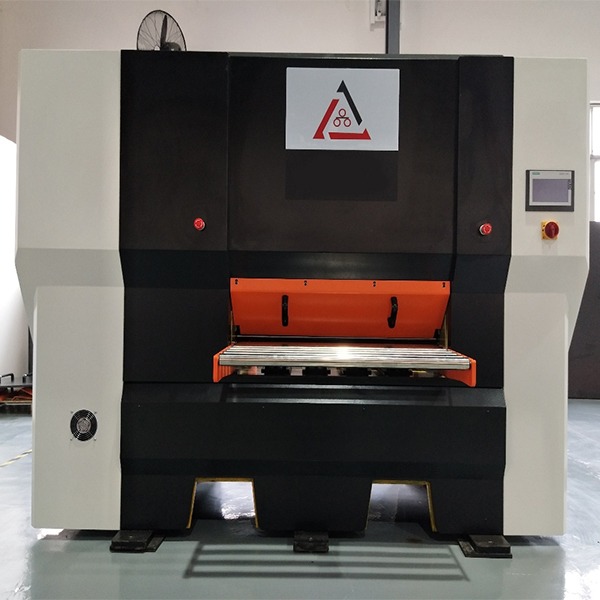
In industrial metal forming, achieving a flat sheet is only half the battle. The true measure of success is ensuring that flatness is permanent—that the material does not warp or spring back after cutting or welding. This permanent stability is achieved through the deliberate scientific process of internal stress released, which is the core function of a modern leveling machine. Understanding this science is key to mastering metal fabrication quality.
The Origin of the Problem: Locked-In Stress
Internal or residual stress is not a defect introduced by the leveling process, but rather a condition inherent in the material when it arrives. These stresses are locked into the metal's crystalline structure during prior manufacturing stages, such as rolling, coiling, or heat treatment. They exist in a state of uneven tension and compression across the material's cross-section, manifesting as curvature, coil set, wavy edges, or center buckle.
If these stresses are not addressed, they will cause the material to distort unpredictably during subsequent fabrication, leading to misalignments, poor fit-up, and scrap. Simply bending the sheet flat temporarily does not solve the problem; it only adds a new stress to counter the old one, resulting in an unstable, high-stress part.
The Leveling Solution: Controlled Plastic Deformation
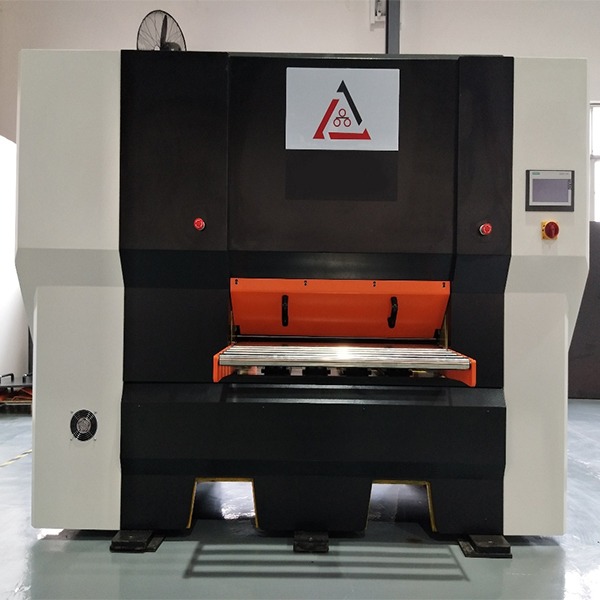
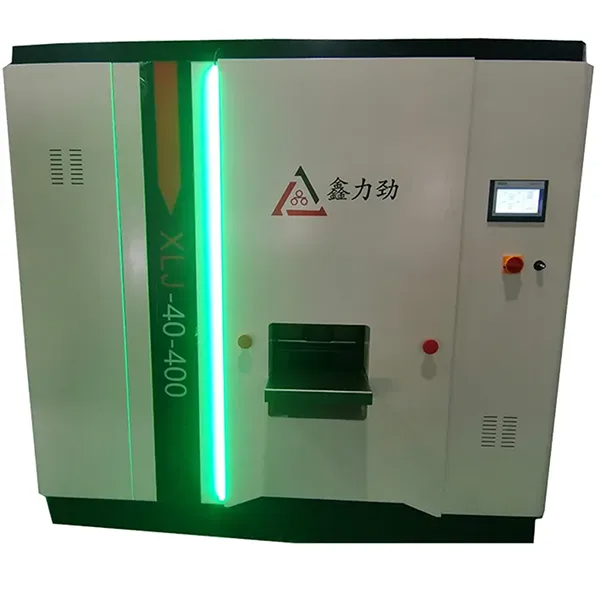
A roller leveler is engineered to be a stress-neutralizing device. It works on the principle of controlled, alternating plastic deformation. The machine's intermeshing rolls bend the metal sheet in a progressively diminishing wave pattern.
-
Exceeding the Yield Point: As the sheet enters the machine, it is bent sufficiently by the first few rolls to exceed its yield strength. This causes permanent, plastic deformation in specific fiber layers of the metal.
-
Leveraging the Bauschinger Effect: Critically, the next set of rolls bends the sheet in the opposite direction. Here, the Bauschinger Effect comes into play: the metal's resistance to yielding in this reverse direction is significantly lower. This allows the machine to re-yield the material with less force, effectively "working" the metal without over-straining it.
-
Progressive Neutralization: This sequence of alternating bends continues through the roll stack. With each pass, the amplitude of the bend decreases. The original locked-in stress pattern is systematically broken down and redistributed. The opposing stresses introduced by the machine itself are carefully balanced against each other.
The Result: A Metallurgically Stable Product
The outcome of this scientific process is a sheet where the internal stress has been released and homogenized. The tension and compression forces are no longer locked in a problematic, uneven state but are balanced to a near-neutral condition throughout the material.
This leads to:
-
Permanent Geometric Stability: The sheet remains flat without springback.
-
Predictable Fabrication: It will not distort during cutting, punching, or slitting, as there is no significant residual stress to re-equilibrate.
-
Improved Weld Quality: Welding on stress-relieved material reduces the risk of distortion and cracking in the weld zone.
Conclusion
The process of metal leveling is a precise application of materials science, not just a mechanical flattening action. The core objective of a high-performance straightening machine is the scientific release of internal stress. By understanding and harnessing principles like controlled plastic deformation and the Bauschinger Effect, these machines transform stressed, unstable metal into a dimensionally reliable, metallurgically stable workpiece. This fundamental understanding is essential for any manufacturer seeking to eliminate distortion and ensure consistent quality in their final products.
Recent News